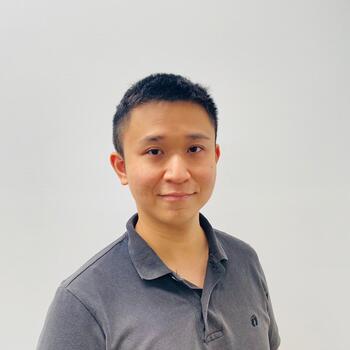
David Chan is a specialist physiotherapist. He is specialised in helping patients with their rehab journey after stroke, Parkinson disease and other physio-neural conditions.
Transcript Available
Ryan: Welcome to the Speak My Language program. In each episode, we share the wonderful life experiences of people with disability living in our multicultural community. I'm your host, Ryan Chen, and I work for the Ethnic Communities Council of Queensland. In this program, we will hear how people with disability living in our multicultural community use newly acquired skills and community resources to live well every day. We not only invite people with disability to tell their own stories, but also invite special guests from various organisations to share useful information, including great places to go and activities and opportunities suitable for people with disability. Our guest today is David Chan. David is a physiotherapist from My Rehab Team.
David: Hi, everyone. I'm David, and I'm a physiotherapist.
Ryan: David will share some information with us today about rehabilitation services. He will also talk about some inclusive and accessible facilities and services in the community. I believe this information will be meaningful and interesting for many listeners. In addition, for those listeners outside of Queensland, don't worry, because at the end of the program, we will share how to find similar types of services in other states or territories that you can access in your local area. Hey David, I heard that your organisation provides some special rehabilitation services to people in need?
David: Yes. Our organisation is basically a community-based service provider, which means that most of our consultations are in the form of home visits. We primarily offer neurological physiotherapy and rehabilitation services. This type of service is usually suitable for people with neurological disorders. For example, those with Parkinson's disease often require our services. Post-stroke patients who need rehabilitation to walk again also use our services. On top of that, we also provide occupational therapist services to help clients return to a normal life. We have exercise physiologists (also known as sports therapists) as well, who assist with physical activity routines. We provide psychologist (or psychotherapist) services. We also have speech pathologist services, as many patients with neurological disorders have difficulty in verbal communication. In such cases, speech pathologists can be helpful in supporting effective communication. We even have podiatrist and nutritionist services to complement our other offerings mentioned above, so as to maximise the effectiveness of our treatment results. Besides all these, we also have many rehabilitation assistants. They can support your current rehabilitation program or therapy to help you get better results and encourage increased participation in your rehabilitation.
Ryan: That sounds like a very comprehensive service. I also learned from your website that you can provide the above-mentioned services at the homes of the clients, is that correct?
David: Yes. Like I just said, we are a community-based organisation. We prefer a person-centred approach. We mostly visit clients at their homes for consultations and treatments. Some patients or listeners might think: "They are in my home? I am a little concerned, as I am not familiar with this person." In that case, we welcome everyone to visit our local clinics.
Ryan: So they can also visit your clinics?
David: Yes.
Ryan: Great. David, another question - since we haven't introduced you in detail, could you briefly describe what your role is in the organisation?
David: No problem. As the title suggests, I'm a physical therapist. I specialise in physical therapy, rehabilitation and rehabilitative treatment of neurological disorders, with a special focus on conditions like Parkinson's disease, stroke, and other rare conditions. I also teach at various Queensland universities - universities within Queensland, not necessarily just the University of Queensland - and I work as a clinical educator. I have also trained both new and student physical therapists, providing them with hands-on instructions and teaching them certain skills. I have also developed strategies for our organisation regarding ways to respond to COVID-19, coming up with plans to prevent the pandemic from affecting our patient services and treatments. Indeed, I wear multiple hats, since I am also responsible for the education of rehabilitation and recovery assistants, as well as drafting rules and procedures regarding them. On top of that, I have recently been working with local GP clinics so that their patients can be referred directly to me if they need physiotherapy.
Ryan: You do hold a wide range of roles indeed. Thanks for taking the time for this interview.
David: No worries.
Ryan: I'd like to know, considering there are many people using your services, who are physically affected in various ways by accidents or health conditions and aiming to regain certain abilities, can you explain the arrangements you have in place to help them gain more autonomy and the ability to live more independently?
David: Living independently and autonomously is one of the fundamental principles of our organisation. We operate with a person-centred approach, where patients must be able to put in effort themselves. On this basis, we provide patients with training in walking, moving around, communication skills, and the ability to do things independently every day and practise self-care such as personal hygiene, cleaning and even household chores. For some patients, who may be younger or keen on work or study, we can also help them gain some autonomy in these areas and train them to make up for their disadvantages. We often collaborate with other medical professionals to provide comprehensive reports for people to present to other healthcare experts, so they can gain a better understanding of your conditions and how they can help you. Beyond training, for those patients who wish to work, study, or learn but lack transport or communicative means, we can also prescribe mobility aids, such as wheelchairs (electric or manual), or even simple crutches or walkers. We can help arrange and purchase them. For patients with communication barriers, we can help them with communication training and autonomy. On top of that, we use high-tech communication therapy and communication aids to enable them to communicate smoothly. As an example, the famous scientist Stephen Hawking's academic achievements depended on his high-tech communication aids for interaction and academic exchange with other scientists. Those kinds of assistive devices are what we can manage to provide. Just to give you an idea of the types of high-tech communication aids available. Depending on each individual's situation, we coordinate with the manufacturers to take measurements and make customised communication aids.
Ryan: It sounds like there are many possibilities to get help, thanks to the technological advancements. So you can provide these ideas, or help them connect with other external technology providers so that they can access appropriate solutions.
David: Yes, that’s right, that's a good way to put it. Besides technological aspects, we also assist with other matters. For example, for some people, the layout of their home may not be convenient for them, especially after they develop the condition and their mobility or communication become impaired, making the design of their home unfriendly. We help patients with the layout of their home, collaborating with external contractors to make their home more accommodating for them. For example, if you have difficulty standing up in the bathroom, we can arrange for external providers to come and install safety features in your bathroom, helping you stand up easily so that you are safer and less likely to fall. We do have arrangements like this.
Ryan: Got it. David, one of the themes of our program is called "Living Well with Disability". Living well, of course, often includes engaging in hobbies and interests. I'd like to know, apart from the basic life skills support you mentioned, could you give our listeners examples of clients who have hobbies they wish to continue despite their disability and need specialised plans to assist them?
David:Sure. Let me give you two examples, one smaller and the other larger. A smaller example is, we have a patient with Parkinson's disease. His wish was less of a hobby and more of a simple request. When he lies down to sleep, he wanted to do it without getting in the way of his wife or rolling over onto her due to his condition. This is because Parkinson's disease can cause a cognitive disorder that results in spatial misperception or cognitive difficulties, making them feel that everything is too close and they can't navigate around objects. Many things, while not perceived as obstacles by other people, would appear like insurmountable barriers for people with Parkinson's disease. For such a small request, we provided a tailor-made treatment program. First of all, in terms of physiotherapy, we used neurological physiotherapy to treat the cognitive disorder of Parkinson's disease, helping to desensitise his heightened sensitivity and allowing him to feel that the road is navigable, even if narrow. At the same time, we provided cognitive training with strategies to overcome obstacles. We provided physiotherapy to train his leg strength and body coordination, preventing cognitive and mobility issues from affecting his ability to rest comfortably in bed. In terms of occupational therapy, we may provide him with assistive equipment that can help him get in and out of bed with ease. For speech therapy, we can provide him with communication training, as patients with Parkinson's disease often have difficulty communicating, halting mid-speech for prolonged periods as if frozen. After the multi-faceted training, the patient with Parkinson's disease was able to get in and out of bed without causing any quarrels with his wife, as he won’t roll over onto her when he sleeps. This is achieved by developing a series of treatments based on his simple request. The person-centred approach means helping people based on their needs. Another case was a gentleman with a brain injury. His symptoms after the injury were no different from those of a stroke. Initially, we helped him with stroke-centred treatment. Later, as he improved in health, mobility, and communication, he expressed a desire to go back to soccer-playing. This requires extensive physical training and balance training, as you can't kick the ball with both feet at the same time. You need to stand on one foot and kick with the other; you also need to be able to run, jump, turn, and work together with your teammates with good communication skills. So we moved his rehabilitation setting from home to the park and to the soccer field. We started to incorporate some soccer-playing elements to his training. For balance, we would train him to kick the ball with one foot without falling. In terms of mobility, we started by training him to do short sprints. We also added some soccer-playing elements to his movement coordination training, requiring him to run with the ball. After all, running with a ball is a totally different story, as it makes a big difference to the coordination of your movements, requiring eye-foot and eye-hand coordination. We added soccer-playing elements in a professional way to conduct training in these aspects. I'm proud to share that this patient no longer requires our physiotherapy services, and I have referred him to a sports therapist colleague specialising in ball sports, who can give him better guidance and refine his movements. These are the two cases that I can share.
Ryan: In your second example, it seems that it is possible for your friend to be trained into an athlete, I think.
David: Well, not to the extent of an athlete, because he wanted to play soccer just to have fun with his nephew.
Ryan: Right.
David: Just a simple wish like that. For any interest or learning goals, it actually stems from a simple desire within oneself. This desire does not have to be a grand dream nor a challenging goal. A simple desire can itself be a small goal. We always help our patients find ways to pursue these goals.
Ryan: Thank you very much, David, for sharing these two cases. Especially the second one, as I believe that many people with disability have their own interests and hobbies, and we also know these are vital elements that bring joy to our lives. Therefore, I find your example very inspiring. It can encourage many people to think in that direction if they haven't already accessed services to enhance certain abilities, allowing them to engage in activities they enjoy. I find it very enlightening. David, we've talked a lot about the services that your community-based rehabilitation organisation can provide, which is a wide range of services indeed. The final story you have shared, that one in particular is really inspiring. I would also like to know a bit more about other mainstream services and activities in our community that are not exclusively for people with disability, but are broadly used by the general public and inclusive enough for people with disability, considering their well-thought-out accessibility features. From this perspective, are there any places you can recommend the community to explore or try?
David: Yes. No matter where the listeners are from, they can try out their local swimming pools. These swimming pools are usually run in conjunction with local councils and offer a variety of activities and courses, including hydrotherapy services. They have put a lot of effort into this aspect and are very friendly to people with disability.
Ryan: There are also fitness centres and others, right? Could you elaborate a bit on that?
David: Yes. These fitness centres, including the YMCA and some local brand centres associated with local councils, are generally quite good. But some special ones, such as Sporting Wheelies, are for wheelchair users, allowing them to exercise or even engage in competitive sports. Some local councils as well as non-governmental community groups and charitable groups also organise local activities, which are usually easy to find online. These activities are people-centred, making them friendly to people with disability. I highly recommend everyone to participate in such events.
Ryan: Okay, David, for our listeners who are in states or territories outside of Queensland, how can they find services similar to your organisation and activities like those you just mentioned?
David: I’ll list some keywords to search for on Google. First, you can search for "rehabilitation". Another term is "community". If you're looking for services facilitated by local councils, you might search for the keyword "council". These keywords should help you easily locate relevant local services on Google.
Ryan: How time flies, and it’s almost the end of our program. Thanks again, David, for taking the time to talk to us today about the services available to people with disability. What I have personally learned is that, first, our medical services can now offer diverse rehabilitation services for people with disability. In addition, our community has a wealth of activities that can help us rediscover interests or find joy in the rehabilitation process. David, do you have any final messages for our listeners?
David: I hope that our listeners, especially those with disability, can go out and see what information and resources are available. There's an exhibition going on a national tour early next year called "Developing Australian Communities". You can search for these keywords on Google. I will also provide a link to Ryan for easy access. This exhibition is friendly to people with disability. It provides a bridge of communication for people with disability, and helps to provide information and raise awareness, so that everyone knows what services, facilities and resources are available.
Ryan: This event is in 2022. Remember that it will be held at respective venues in different states, correct?
David: Yes. It will be in Melbourne, Sydney, Brisbane and Perth, starting next year. A total of four events will be held in 2022, and then it will become a regular exhibition.
Ryan: Great. Thank you, David, and thank you to all our listeners for listening.
David: Thank you, listeners.
Ryan: If you have enjoyed our program, please visit the official website of Speak My Language at speakmylanguage.com.au to learn more. You are also welcome to share this program with your family and friends. Follow us on our social media platforms Facebook, Twitter, Instagram and LinkedIn to spread our message across Australia and around the world. The Ethnic Communities Council of Queensland is proud to produce the Speak My Language program in Queensland. The Speak My Language program is funded by the Department of Social Services and produced by the Ethnic and Multicultural Communities' Councils and Multicultural Councils of all state and territory. Our broadcasting platform partners include SBS and NEMBC.