


At the heart of living well is a universal need to be accepted, to belong and to feel personally fulfilled.
We recently interviewed sixteen people who live with a range of disabilities, as well as carers or front-line workers, from ethnic communities across New South Wales. We wanted to understand what living well with a disability means from a culturally diverse perspective. Those who participated in the survey were from Vietnamese, Chinese, Arabic, Indian, Filipino, Nepali, West African and East African backgrounds.
As can be expected, a diverse range of people means a diverse range of experiences. While issues like cultural stigmas around disability and racism from Australian society came up (read our full report here), we also heard stories of positive change within and around culturally and linguistically diverse communities. For example, in some established migrant communities, we heard that community attitudes to disability have shifted over time, becoming more positive and inclusive.
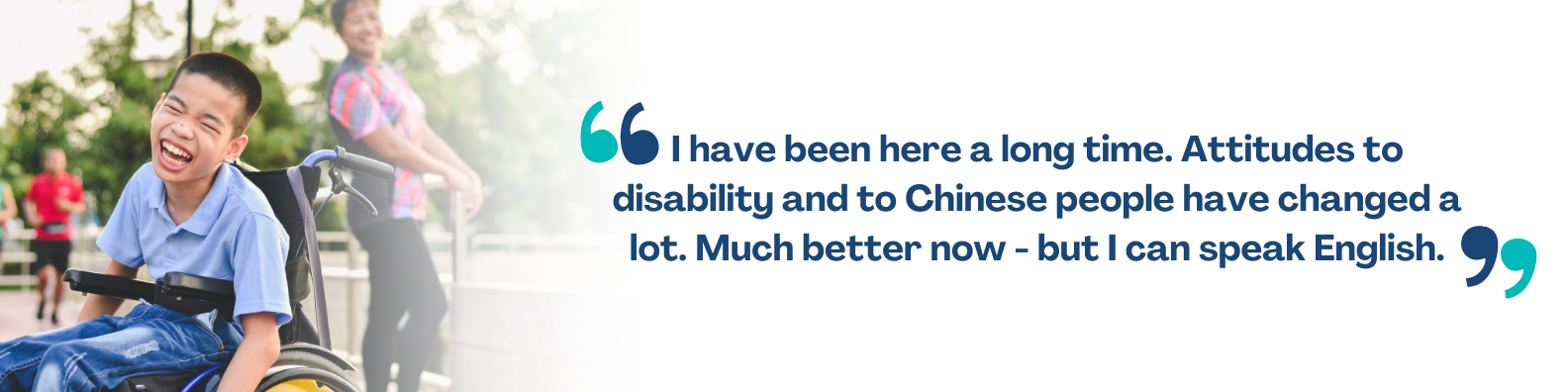
As one Chinese Australian carer summed up, “I have been here a long time. Attitudes to disability and to Chinese people have changed a lot. Much better now - but I can speak English.”
Could this mean that the growing mainstream awareness and acceptance of disability in Australian society is also occurring in our migrant communities? We are curious if this experience is shared beyond the individuals we interviewed.
Understanding and accessing resources to support living with a disability is clearly an important part of living life to the fullest. Over the last decade, we have seen a significant improvement to Australia’s translation services, translated materials and interpreter availability. Participants from Arabic, Vietnamese and Samoan speaking backgrounds noted positive experiences in accessing resources and materials without language barriers. One Arabic speaking participant celebrated the availability of multilingual workers in the government sectors, “there are many employees who speak Arabic, like in Centrelink, or Council. The government recognises this by having translators and printed translated pamphlets.”
There is still more work to be done to reduce barriers to inclusion, but Speak My Language wants to hear from you about where we are getting it right. We want to learn and grow from those places where people are successfully inclusive of language and cultural difference, as well as disability. Have you got an example to share?
Some communities use younger members to translate for older friends or relatives. The Vietnamese and Samoan participants both said that intergenerational connections can help bridge language barriers when accessing services. This only reinforces the importance of having strong connections in our personal networks and communities. The more connected we are, the less barriers we face, and the easier it is to live well.
For most of us, our intimate circle of family and loved ones are the people we are closest to and often turn to when we need support. This is followed by our friendships, the bonds secured by common interests and activities. From there, our social ties become weaker but no less important. Our colleagues, neighbours and those in paid relationships still make up a valuable part of our support network and social experience.
For those facing significant language barriers or racial discrimination, safe spaces are limited. This is a key reason why culturally diverse people with disabilities and their carers spend most of their time with close and extended family, and friends within their community. One Chinese speaking carer explained, “I have a child with autism, and I feel safe within my local community, because they are from the same cultural background.” This feeling of safety and belonging helped culturally diverse people with disabilities and their carers form stronger relationships.
Still, when it comes to family members who double up in a caring role, we need to strike the right balance. One Samoan participant noted that family members can sometimes be overprotective when it comes to a disabled person they care for. He said, “very often, parents are very protective, but really are controlling. I don’t think that’s the way.”
Those from different migrant backgrounds often relate to the experience of having parents whose loving protection can become a bit stifling. While this is not everyone’s experience, it is so common it has long been the subject of many routines of Australian comedians from migrant backgrounds.
However, for a person with a disability, life can become very limited indeed. A parent may fear their child being exposed to negative attitudes and stigma from outside and within one’s cultural community. Some families may try to remove all risk by not going to new places, by not meeting new people, by not trying new things. Removing these risks also removes opportunities - opportunities to build new skills, develop a sense of autonomy, make new friends, find new support networks.
Maybe you and your family have taken a risk to venture out into your community and it turned out great. Or maybe you have been thinking about this but don’t know how to take the next step? We would love to hear about your experience.
While our connections with family can play a big part in living well with a disability, it is equally important that people can exercise the independence to forge relationships beyond the family unit, for instance with friends or colleagues. Certainly among those we spoke to, parents who supported their children’s independence witnessed greater community inclusion and connection for their children. One Filipino mother noted that because of her daughter’s NDIS package, she can go out to concerts or to the club with a friend who also has a similar cognitive disability. This has greatly increased her daughter’s happiness and enriched her relationships outside of the family.
One Samoan participant who acquired their disability due to injury said that their ability to return to university and get a job were game changing. This not only empowered them personally, but it helped them to influence the Australian Samoan community on what living well with a disability means, and what people with a disability have to offer the community.
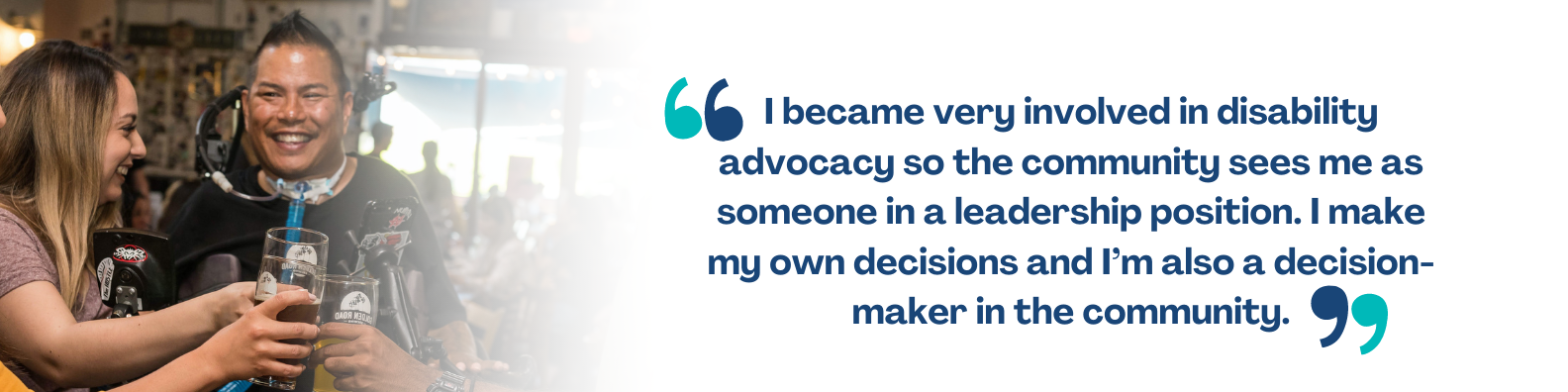
"I became very involved in disability advocacy so the community sees me as someone in a leadership position,” they explained. “I didn’t see myself as dependent on anyone. I make my own decisions and I’m also a decision-maker in the community."
Beyond immediate family, one of the key points of social connection among the people we spoke to were places of worship. For many, religion played a vital role in shifting perceptions around disability and making cultural communities more inclusive. Amongst the Chinese Australians interviewed, places of worship, like the church or temple, doubled as welcoming, inclusive, social spaces and support networks.
Many diverse cultural communities have a strong connection to their faith. The messages they receive in these spiritual spaces shape the way they are treated, in positive or negative ways. People with disabilities from African, Nepali and Samoan backgrounds all noted that their religious communities continue to be impacted by superstitions or stigma about disability. However, there may be people in these communities doing incredible work to challenge stigmas and make their communities more aware of disability inclusion. Do you have a story about that? We’d love to hear it!
We certainly heard some examples of how empowering spiritual messages have created greater acceptance and understanding of disability. One Arabic speaker said their faith has helped break stigmas, “in Islam, mental health is recognised as an issue. You need to seek help, medication, spiritual belonging.” This shows us that the beliefs cultural communities hold about disability can shift over time, and become more positive or nuanced, depending on the messages share within the community.
We are so grateful for the stories and thoughts our focus group participants shared with us. We have so much to talk about and to learn. Not just about what isn’t working, but more importantly, about what is! We want to better understand where and how culturally diverse communities are becoming more inclusive.
Have you seen attitudes towards disability change in your cultural community over time?
We want to know what is driving those changes. The more we know, the easier it will be for people to live well with a disability.
Acknowledgements
This article is based on a submission by Teresa de Leon, on behalf of the Ethnic Communities Council of NSW, for the Royal Commission into Violence, Neglect, Abuse and Exploitation of People with a Disability. The original submission can be viewed here.
The Ethnic Communities’ Council of NSW would like to thank the many individuals who generously contributed their personal experiences and stories. We also gratefully acknowledge the collaboration of our many Member Organisations that assisted ECCNSW to organise and host focus groups and interviews. To protect the anonymity of the focus group participants (as requested) we have not included the details of these Member Organisations.
Want to contribute to Speak My Language?
Learn more about the program here or contact info@speakmylanguage.com.au