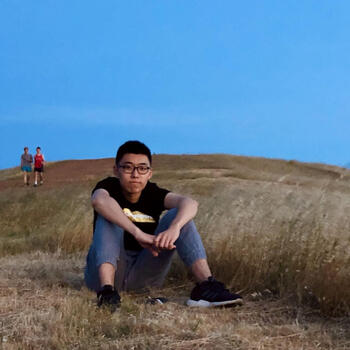
Aaron is a landscape architect based in Adelaide who loves plants and nature. Aaron encourages people with or without a disability to spent more time in nature and would like to highlight that nature is a safe, inclusive, and welcoming place for everyone.
Aaron demonstrates the concept of landscape healing through the creation of the art work "a treatment of anosmia", which was the runner-up in 2021 Further Landscapes competition held by AILA (Australian Institute of Landscape Architects).
You can learn more about it by visiting https://www.aila.org.au/SC/SC/Speakers/Treatment%20of%20Anosmia.aspx
Transcript Available
Rui: Hello everyone. Welcome to the Speak My Language program. Here you will hear from people from multicultural communities about living well with disability. My name is Zhou Rui and I work for the Multicultural Communities Council of South Australia. In our interviews, we learn from people with disability from multicultural communities about how they use their skills and community resources to live well wherever they are. We'll share personal experiences, tips and ideas from people with disability and from other people who can tell us about accessible places, activities and opportunities. Our guest today is Aaron, a landscape designer who will share information about landscape healing, which I believe will be very useful to many people. Hello Aaron, welcome to our program.
Aaron: Hello Rui, thanks for having me.
Rui: Could you start by telling us what a landscape designer is? What do landscape designers mainly do?
Aaron: My understanding is that, landscape designers are a group of people who can change the world. We can change our living environments, such as the parks around us, beautiful flowers and plants, gardens and so on. We like to observe and imagine - we see the environment as it is now and imagine what it could become, then showcase our ideas to everyone. This is a discipline that integrates science and art, so we need to apply some basic scientific knowledge and incorporate some excellent artistic concepts to present a beautiful blueprint. That's the profession in my understanding.
Rui: Okay, so that means landscape designers are closely related to everyone's life.
Aaron: Yes.
Rui: May I also ask why you wanted to become a landscape designer?
Aaron: The main reason for becoming a landscape designer is because I love the outdoors. I enjoy being alone in nature to get to know the planet that nurtures us. So I feel this profession brings me closer to nature. I also like art and wish to change things with my ideas. So, when I see some social phenomena, whether good or bad, I will reflect on them and hope to make the world a better place with my expertise. This is why I chose this profession.
Rui: That’s a very romantic understanding, indeed.
Aaron: Yes.
Rui: As a landscape designer, what part of your actual work is your favourite?
Aaron: I actually have many favourites. If I had to pick one, it would be the ability to protect the entire ecosystem of the Earth because you can often look at things from different perspectives. For example, when we work with architects, they may have their own ideas, but we will make suggestions from an environmental perspective and safeguard the fundamental rights of the ecosystem with our expertise. So in this profession, sometimes I feel like a fighter, helping solve environmental problems. This is what I like the most.
Rui: And as a landscape designer, it means that if you have ideas, you can turn those ideas into reality through practical architectural or environmental elements - it’s a process like that.
Aaron: Yes, this is also a part I really like to see, it’s a bit like giving birth to a life; it’s very satisfying when you see a work of art completed.
Rui: That’s great indeed. I've also learned that you recently participated in a project called "Treatment of Anosmia", and this work won the runner-up prize in the "2021 Future Landscapes Competition" hosted by the Australian Institute of Landscape Architects. Congratulations to you.
Aaron: Thank you.
Rui: Could you give us more details about this work?
Aaron: Sure, no problem. This competition mainly asks us to imagine what the Australian landscape would look like in the future - what kind of cities we would live in and what kind of living environments we would have. We took the recent COVID pandemic as inspiration. Many people who got infected lost their sense of taste and smell; such long-term effects are common among many people. This inspired us to come up with our concept of a patient recovering from anosmia. Nowadays, many have lost their basic senses such as smell and taste, and I think this problem might become more troublesome in the future. And it's not just caused by current diseases. Often, living in the city, we have less and less contact with nature. We may find our senses slowly degrading because we're constantly exposed to the same things and not environments that would stimulate our sense of smell or hearing. Our senses adapt to a world lacking stimulation, and as a result, they deteriorate. Therefore, the main idea of our design is to enable people to recover these senses through plants and designs. We hope that people can have more contact with nature to heal themselves; at the same time, we are also healing nature, because only in the process of healing nature can we heal ourselves. That was the theme of our entire project in the competition.
Rui: So your inspiration is from - I have also seen news about how some COVID patients might lose their sense of smell.
Aaron: Yes, exactly, and we have had some thoughts from this.
Rui: That’s very creative.
Aaron: Thank you.
Rui: What key message do you want to convey to the audience?
Aaron: We want to express to the audience our expectations for the future. Because currently we have noticed a lot of uninspired streets in the city, primarily used for commuting, and we sometimes forget that our environment could be improved, and we could have more diverse experiences when walking on our streets. Therefore, we've included in our design a lot of plants and flowers that can stimulate people's senses, and we used a range of different facilities so that people could gain different stimulations through sight, hearing and smell. They can awaken their memories of nature by watching the movement of water and hearing the birds singing. This is what I expect from the users.
Rui: May I understand it as, even if you have lost your sense of taste and smell, or if you are living with disability, you are strongly encouraged to engage with the environment and have more contact with plants, as this can better support your recovery?
Aaron: Absolutely right. Because the concept we had in mind while doing this is inclusiveness. It allows everyone in this society, no matter what type of user you are or what your background is, to use this space and the facilities we have designed for you. For example, a park is accessible to everyone. It is the most basic form of equality. No matter what disability you have, or your age, or how much you love nature, you'll find something in here that you can use. In particular, we will take into account that people with disability might have a greater need for recovery. There are many places where plants can be used to help them heal, so they actually need this place more.
Rui: Yes, indeed. Because I understand that in your work, there is a statement like this: plants do not judge people's past, background, or abilities.
Aaron: Yes, they are all-inclusive and tolerant of everything, which aligns with the entire concept of equality. So I believe it also reflects one of the themes we wanted to express in the competition.
Rui: Yes, this work is indeed very creative and inclusive. So how did you feel when you found out that your work won the runner-up?
Aaron: Of course I was very happy, and actually quite surprised. I didn’t expect to win the runner-up. I am very grateful to my teammates, as there were three of us who discussed and finalised the work together, and the process itself was very enjoyable. I was even happier after winning the award; it really was the icing on the cake.
Rui: We also want to share this joy with the listeners of our program, so we will put the link to this work in the episode description. Interested listeners can click on the link and experience the healing power of landscape with us.
Aaron: Alright.
Rui: We would also like to ask, Aaron, as a professional landscape designer, what is your understanding of the healing effect of landscape?
Aaron: I think when it comes to landscape healing, it’s based on science to some extent. It has a lot of theoretical basis, and it essentially requires us to understand what it is that needs healing. Any one of us may have certain aspects in life that could benefit from the healing power of nature. Once we know what we want, we can meet these needs by means of landscape. Moreover, throughout history, landscape, including plants, has always been a way to heal people. In ancient times, people used herbs, grew vegetables and spices; nowadays, we plant colourful flowers in cities. All of these are ways to heal ourselves. It's only getting better now, and this trend might become very popular in the future.
Rui: As mentioned before, different ways are used in the landscape design process to help people with disability use the space better. Could you give us some examples in this regard?
Aaron: I think that being able to help people with disability is essential in the design process, because they are the community that needs our understanding and recognition the most. For some people, we will take into consideration that some slopes in the park may be too steep for them to push their way up, so we will think about the slope and make it more convenient. There are also things like having something tactile in front of the stairs to make people aware that they are walking up the steps. These are all necessary designs. In the park, we can use fountains and the sound of water to inform some people that there is a fountain here. Even though they can't see it, they can hear it. We can also plant some fragrant plants in the garden, providing hints for them through different senses that there are wonderful things waiting for them to discover. So, many details like these are considered. Another thing to mention is that people who use wheelchairs often use raised garden beds, such as plant platforms, where they can choose to plant flowers and engage in gardening. This hands-on participation is also a way for them to experience the landscape.
Rui: You did put a lot of thought into it.
Aaron: Yes. Attention is paid to those details, and the Australian government also has standards for us to follow, so it is actually a very important aspect.
Rui: Next time I go to a park or a plaza, I will make sure to keep an eye out for these aspects and pay more attention.
Aaron: Sure, no problem.
Rui: So here we also encourage people with disability or special needs to interact more with these landscapes. Also, as our listeners are from all over Australia, I would like to ask Aaron if you can recommend some locations with healing landscape across Australia for us?
Aaron: No problem. I would like to recommend three or four places. What I want to recommend most is that you should visit the botanical gardens in your local cities more often, because they have designs that are accommodating for people with disability and feature a wide variety of plants for people to experience. For example, in the Adelaide Botanic Garden, there is an area of special purpose called the Sensory Garden, where visitors can stimulate their senses by walking in this garden. They can hear the sounds of bees and butterflies flying, birds singing, and smell many different scents. So the botanical garden is the first place that I recommend everyone to visit. Next, there are some well-designed places. For example, there is a rehabilitation centre in Brisbane called STARS. The external environment of this centre is fantastic, with the building wrapped with lush green vegetation. Patients recovering from surgery will forget that they are actually in a building when walking under the lush green plants. They will feel like walking in a maze, and the environment is conducive to their healing process post-surgery. This is a very good design. Another one is a hospital in Bendigo, Victoria. It has a large high platform with extensive steps, each covered with lots of plants. For patients in recovery, they can see a lot of plants while exercising on this platform, and feel like they are in a dense forest. This environment is also conducive to patient's healing process. There are also other specific projects, such as Tea Tree Plaza in Adelaide, a shopping mall with user-friendly design. It uses various plants to create a lush world. Visitors will feel like shuttling between indoors and outdoors, and the whole environment is very healing. After I went there, I found it captivating. So there are many such designs in our lives, including our neighbourhood parks. In fact, putting down electronic devices, going outside to look at other people's gardens, enjoying the beautiful plants in the entire neighbourhood, and taking a walk on the street are all excellent choices.
Rui: Thank you Aaron for the recommendations. I hope our listeners will have the opportunity to visit the above-mentioned places and experience them. Now we are coming to the end of the program. Thank you very much Aaron for sharing with us information about landscape healing. I am also very happy to have had the opportunity to learn about the positive effect that landscape has on everyone, and the special attention that landscape designers like Aaron give to people with disability or special needs during the design process. Many thanks to Aaron for his recommendations of places around Australia. Is there anything else you would like to share with our listeners, Aaron?
Aaron: First, I would like to thank Rui for inviting me to share my work. I would like to share one last thing: the process of healing nature is also the process of healing ourselves. Nature is very forgiving and can embrace everyone. I hope that in the future, everyone will find something wonderful in nature.
Rui: Thank you very much for sharing, Aaron. At the same time, thanks to our listeners for listening.
Aaron: Thank you.
Rui: If you like our program, please visit our website speakmylanguage.com.au, where you will find more. You are also welcome to recommend the Speak My Language program to others. You can find us on Facebook, Twitter, Instagram or LinkedIn and help us continue this conversation across Australia and around the world. Speak My Language is proudly presented in South Australia by the Multicultural Communities Council of South Australia. Speak My Language is funded by the Department of Social Services and is delivered nationally through a partnership of the Ethnic and Multicultural Communities’ Councils and Multicultural Councils in all states and territories around Australia. Our national broadcast partners are SBS and NEMBC.